
Blog · The workshop
Why I design and make my tools myself (twelve versions before the right one)
I have never found in the shops an antenna or a pendulum that suited me: too heavy, designed to be sold more than to practise with. So I draw them, and I print them in my workshop in Entraigues-sur-la-Sorgue. Here is the real work, dimension by dimension, the antenna that broke, and what it guarantees you when you buy one.

It all starts with a dimensioned sketch
My practice and my workshop are in the same place, in Entraigues-sur-la-Sorgue, near Avignon. A tool is always born in the same way: a dimensioned sketch, that is, a drawing by hand with all the measurements written on it. I then have it put into 3D (a file the printer can read), and I print it on my 3D printer, in PLA, a plant-based plastic. Around the PLA, three materials, each in its place: carbon for the arms, brass for the wires of the slider, steel for the rulers.
I was a dental technician, then a teacher of colour for fourteen years at the Ateliers du Carrousel of the Musée des Arts Décoratifs in Paris: the hand and the eye are where I come from. I make things because the right tool did not exist, and these are the tools I have in my hands at each session.
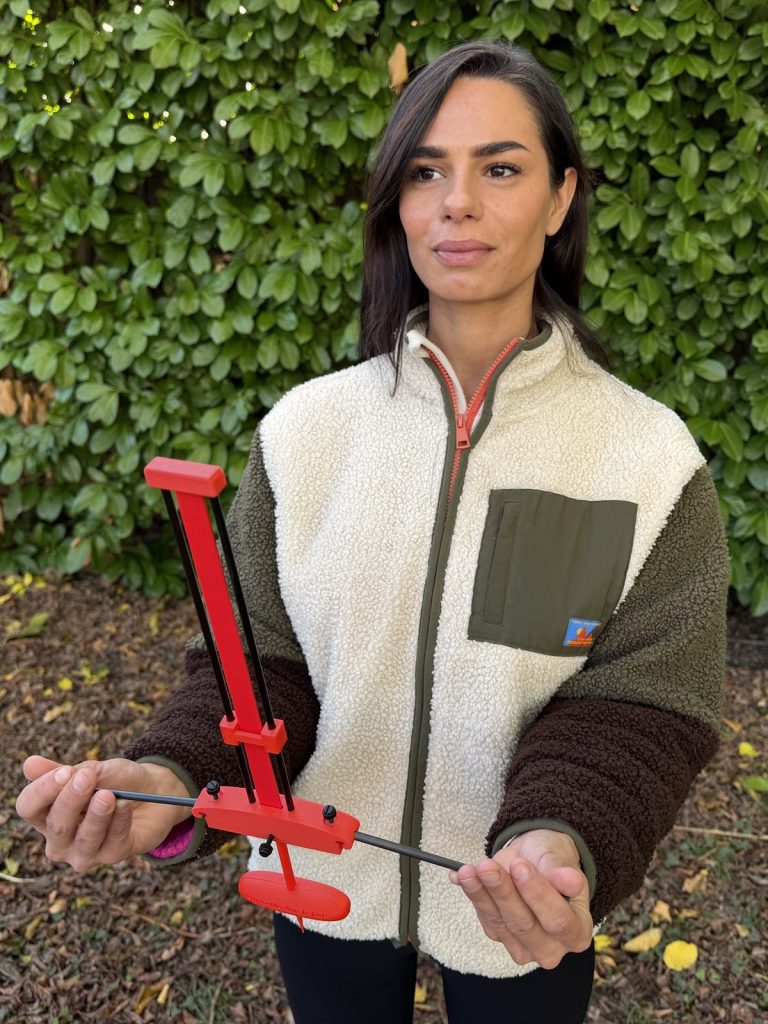
Take my large Hartmann-type volute Lecher antenna. Its body is a shape wave, a shape designed to act through its very shape: a dome, two ends in a round drop (the volutes), 100 mm at the widest, 84.1 mm at the base, 15 mm thick. The arms, the rails and the ruler are centred in this thickness, at the same level. All of that was on the sketch before it existed.
The gauges: each dimension found one by one
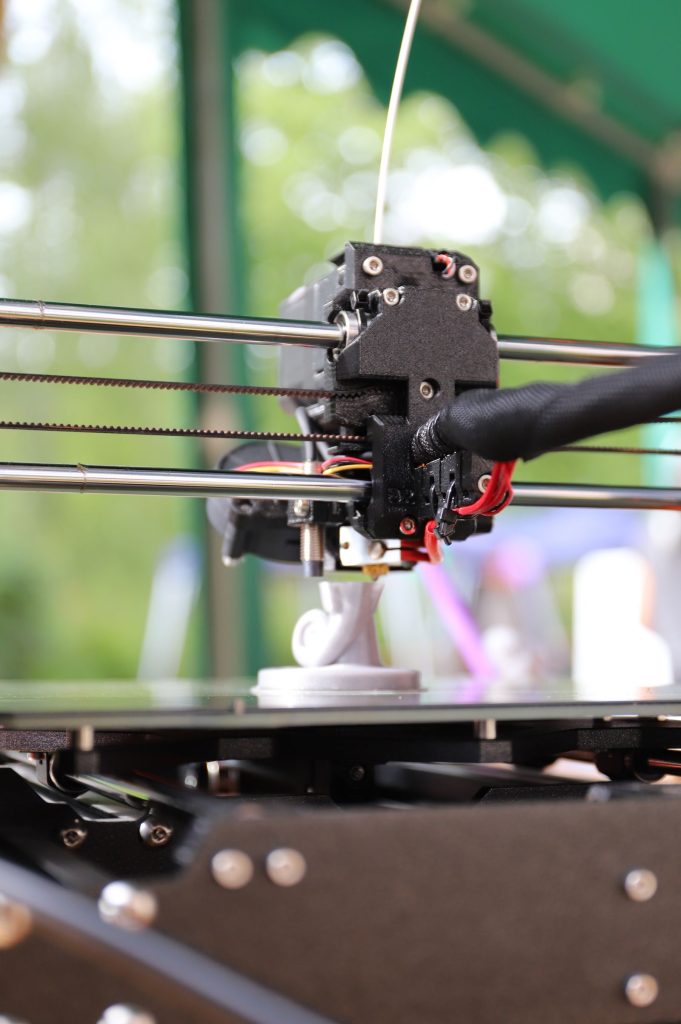
A dimension is not guessed, it is tried. For the large antenna, it took me twelve versions before the right one. Between two versions, I print gauges: small test pieces, drilled at several diameters, to find the hole that holds without forcing, or that slides without play. Each dimension was found like that, one by one.
The rest follows the same standard. The arms are 153 mm, 30 of which are held in the body, and lean 9° towards you. The rails of the ruler are cut to 245 mm. The ruler is 23.4 cm in all: a printed blade of 1.80 mm, on which a 13 mm graduated steel tape is bonded. The slider is in one piece, with a brass wire above and one below, which brush the carbon. The screws are M3 knurled screws in black nylon (a ridged head, which you tighten with your fingers), from above. And under the body slides its counterweight, 7.5 × 2.2 cm for 23 g, which carries the reading point: it balances it, it concentrates the energy, and the antenna is never worked without it.
And no support to tear out of the holes (supports are the crutches the printer adds under a piece and which you then break off): I design so as to do without them.
The antenna that broke: sturdiness before weight
I am going to tell you about a failure, because it is what set my rule. One of the versions of the large antenna was very light. Too light. It broke when screwed. Since then, the order is clear: sturdiness first, weight second. “Thicken the body if necessary” has become my instruction.
Weight comes afterwards, but it is not left to chance. Everything I make is set on the 9 or the 3, because it is on the 9 that I read a person: it is the rule of 9. On the large antenna, the body weighs 26.1 g, the head 3.3 g, the slider 3.3 g, the ruler blade 11.1 g. A body thick enough not to break, and weighed to a tenth of a gram: both at once, that is the whole job.
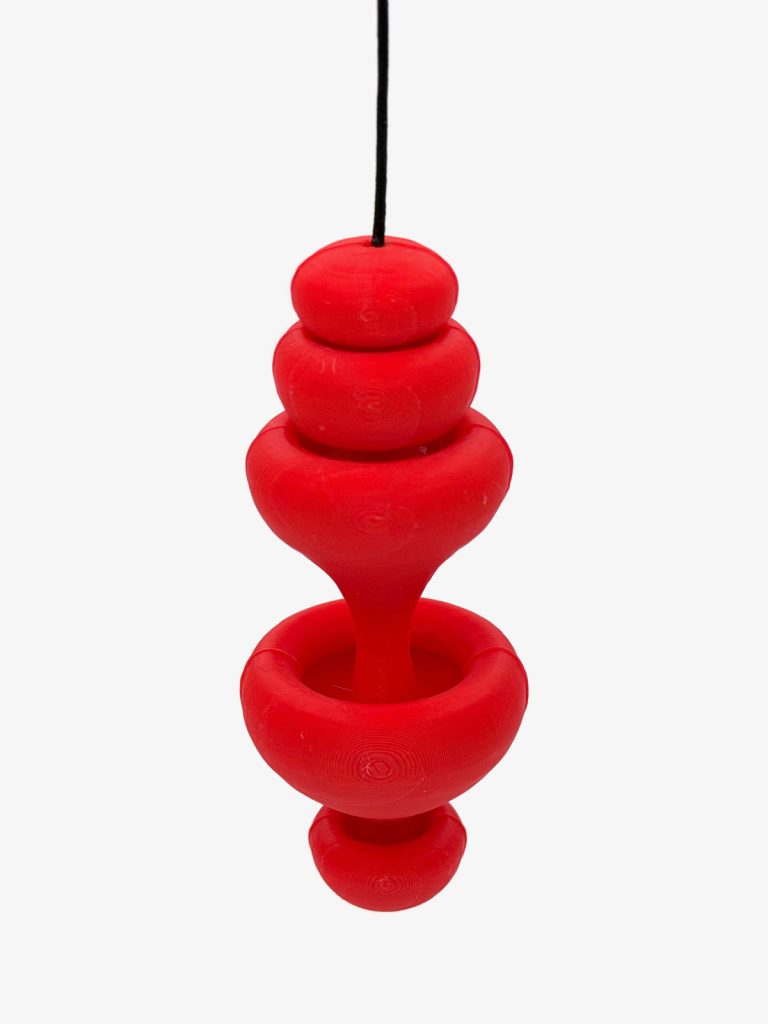
The same rule applies to the pendulums. The volute pendulum of the Jean de La Foye type, 9 cm high, is thickened to 6 mm where it narrows at the bottom, so as not to break; it is printed in two halves lengthwise, with two inserts, and a hole at the top for the string. The two-sphere pendulum of the Bélizal-Chaumery type, 27 g, took several print runs: marks, a seam, an off-centre middle, corrected one after the other. A failed print, I do not sell it, I do it again.
Printed upright, for a smooth face: the jewel effect
The finish matters as much as the dimension. The body of the large antenna, I print it upright: that is what gives a smooth face. On the pendulums, I look for a “jewel effect”: a smooth surface, with no mark or seam. The volute pendulum of the Jean de La Foye type and the two-sphere pendulum of the Bélizal-Chaumery type are both made in red.
Each piece has its printing recipe. The geobiological corrector (Blanche Merz type), three oval pebbles set one on top of the other in a single domed surface, to place in a house, is printed in green PLA with 0.1 mm layers, three walls and a 20% infill (the inside is not solid: a lattice fills a fifth of the volume), to reach 324 g. The protection amulet, the same shape in small, about 4 × 5 × 2.7 cm, is 100% solid, for 33.3 g. And the Lost twin amulet (Georges Prat type), a tilted pebble whose waves in relief were decided with the pendulum, 31.8 g, is now on sale.
What I am often asked
Printed plastic, does it last over time?
Yes, provided you design for that: I thicken where it tightens, and I put sturdiness before weight, always.
Why PLA, and not metal?
Because with PLA, a piece weighs only what it must weigh, to the gram: 26.1 g for the body of my large antenna, and a counterweight that keeps it balanced. The other materials, I keep them where they are useful: carbon for the arms, brass for the slider, steel for the ruler. I say more here: why neither wood nor brass.
What is your printer?
An Elegoo Centauri Carbon, set up in the workshop, next to the practice. It prints everything, from the antenna to the 324 g corrector.
And if the tool does not suit me once received?
You have 14 days to change your mind. Shipping is free in France (€130 outside France), and each tool has the 2-year legal guarantee.
Would you like a tool made for the hand, not for the shop window?
Call me: I tell you which one to take to begin with, and I answer your questions about how they are made. The first assessment by phone is free.
Call +33 6 80 72 12 54or write to me on WhatsApp, or at contact@centre-coherence.fr
What I describe here is an energy practice, for well-being: it makes no diagnosis, treats no illness and replaces neither medical advice, nor a treatment, nor psychological care.