
Blog · The tools
Why my pendulums are neither wood nor brass
People often say it to me, and kindly: “I want wood, or metal.” I understand. I learned with brass and copper, in four schools. And yet everything I make is printed in a plant-based plastic, made from maize and sugar cane. Here is why, simply: a pendulum is first of all a weight at the end of a thread.
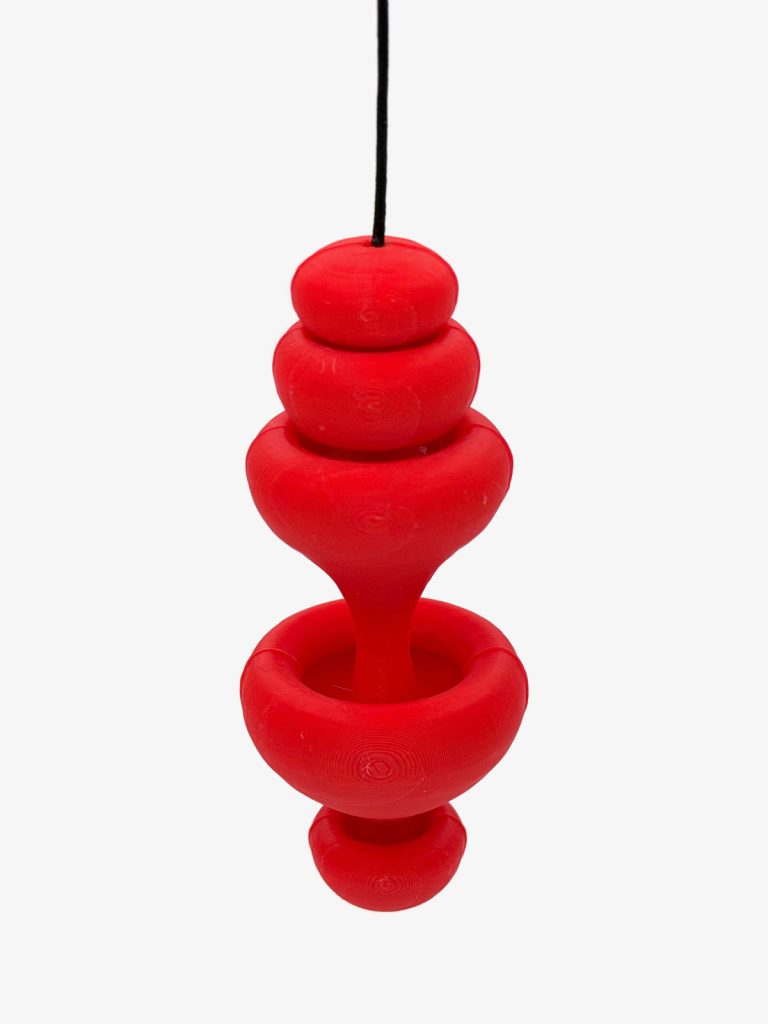
A pendulum is a weight at the end of a thread
Before being wood, brass or stone, a pendulum is a weight, hanging from a thread, with a shape that turns true or turns false. That is what ten years of practice have taught me: the answer comes from the hand, and the hand first feels the weight and the balance. The weight does not change the rhythm of the swing, it changes what the hand feels. Too heavy, the hand tenses and the answer blurs; too light, the pendulum floats. Badly balanced, it traces an oval instead of a circle, and you can no longer read. This is not my own idea: Abbé Mermet, the father of modern dowsing, wrote as early as 1935 that a pendulum can be made of “any other heavy body”, and he advised 20 to 30 g for fine readings.
So I chose in this order: the weight to a tenth of a gram, the shape to the millimetre, and only then the material that allowed me both. My two-sphere pendulum weighs 27 g, my amulets 33.3 g, the body of my large antenna 26.1 g: weights whose digits add up to 9 (2 + 7, 3 + 3 + 3, 2 + 6 + 1), that is my rule of 9, and I check them on the scales at every print run. Wood does not allow that for long: you can sand a piece to the gram, but two pieces of the same tree do not have the same density, and the piece gains or loses weight with the humidity of the house. The wooden pendulums sold in shops in fact weigh 8 to 15 g: to make one of 27 g, you need a very dense exotic wood, or to hide metal inside.
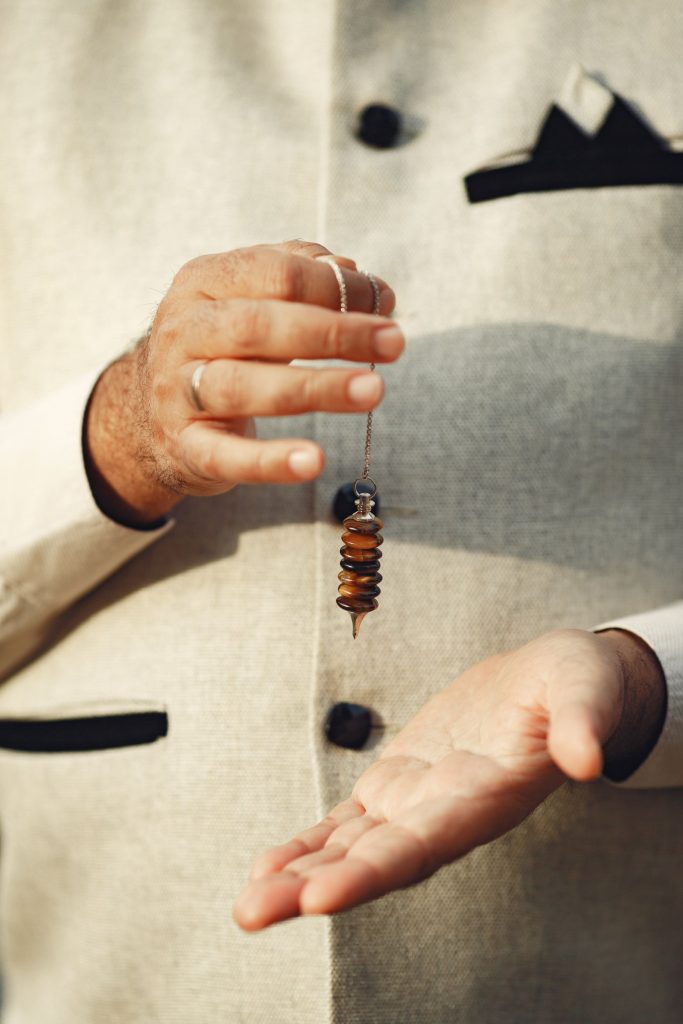
What I keep of wood and brass
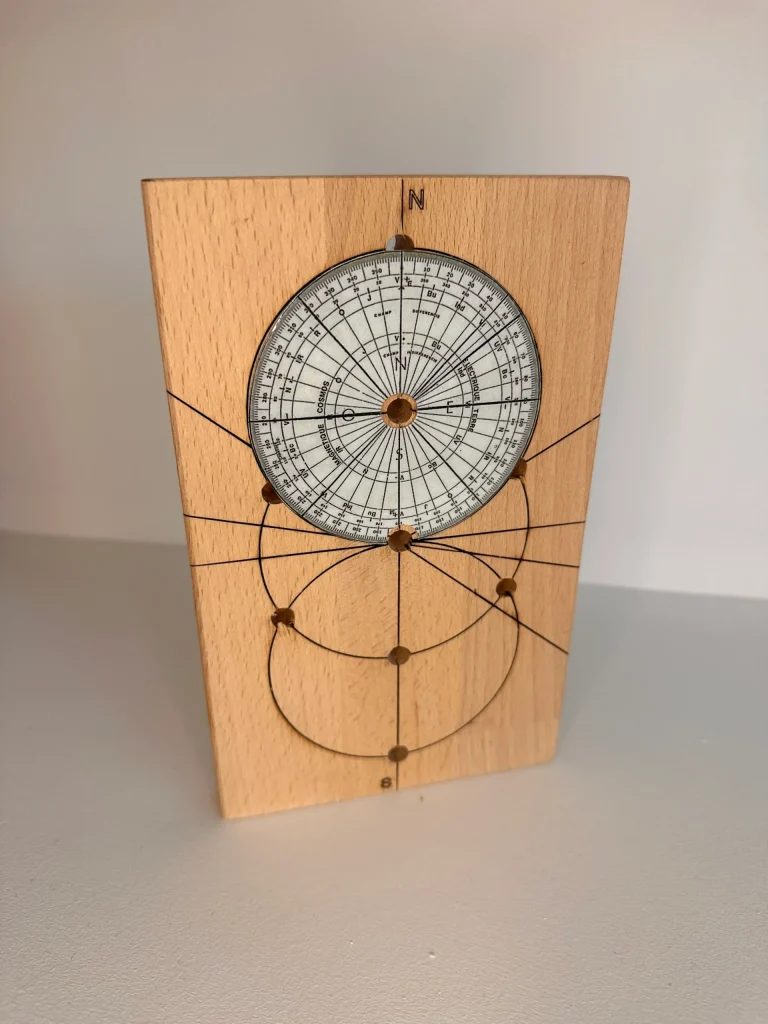
Brass and wood have their nobility, and I do not say otherwise: it is with them that I learned. I keep them where they are useful. On my antennas, the wires of the slider are brass, the ruler is steel, the arms carbon: there, the material works. My Reciprocal Circles, a tool you set down to work on a place, are mounted on a base of solid beech 18 mm thick, because a base must be dense and stable. And my seven shape waves, engraved shapes that act through their very design, are in bamboo, because they are set down and not held.
What is held in the hand, on the other hand, I wanted light, exact, and washable. For that, wood and brass did not give me what I was looking for: brass is heavy and tarnishes, wood varies from one piece to another and has to be varnished. Tradition itself has always preferred for the pendulum materials that emit nothing by themselves, wood, glass, ivory, rather than metal: plant-based plastic belongs to that family. It is not a ranking of materials, it is a practitioner’s choice.
Why plant-based plastic
What I print is in PLA, a plastic made from maize starch and cane sugar, not from oil. It is the family of material used for food cups. Printed layer by layer in my workshop in Entraigues-sur-la-Sorgue, it gives me what I had found neither in wood nor in brass:
- The exact weight, at every print run. 27 g is 27 g, on the first pendulum as on the hundredth.
- The shape to the millimetre. A centre of gravity in the middle, a pendulum that turns true, an antenna whose slider slides without play. For the same weight, plant-based plastic takes up seven times more room than brass: that is why my pendulums are rounder and fuller in the hand, and less sensitive to draughts.
- Nothing on it. No varnish, no glue, no paint: the colour is in the material. No nickel, the most frequent contact allergy, which some alloys and platings contain; and PLA itself contains neither bisphenol A nor phthalates.
- It hardly changes. It does not oxidise, does not tarnish, and does not move with humidity as wood does. In my practice, I find it more neutral: it keeps nothing, neither smell nor trace.
- It can be washed. With water and soap, between two people. Not in the dishwasher: above 55 to 60 °C, it loses its shape.
- It does not chill the hand. Brass is cold in the morning; PLA is at room temperature, and light: the hands stay relaxed after an hour.
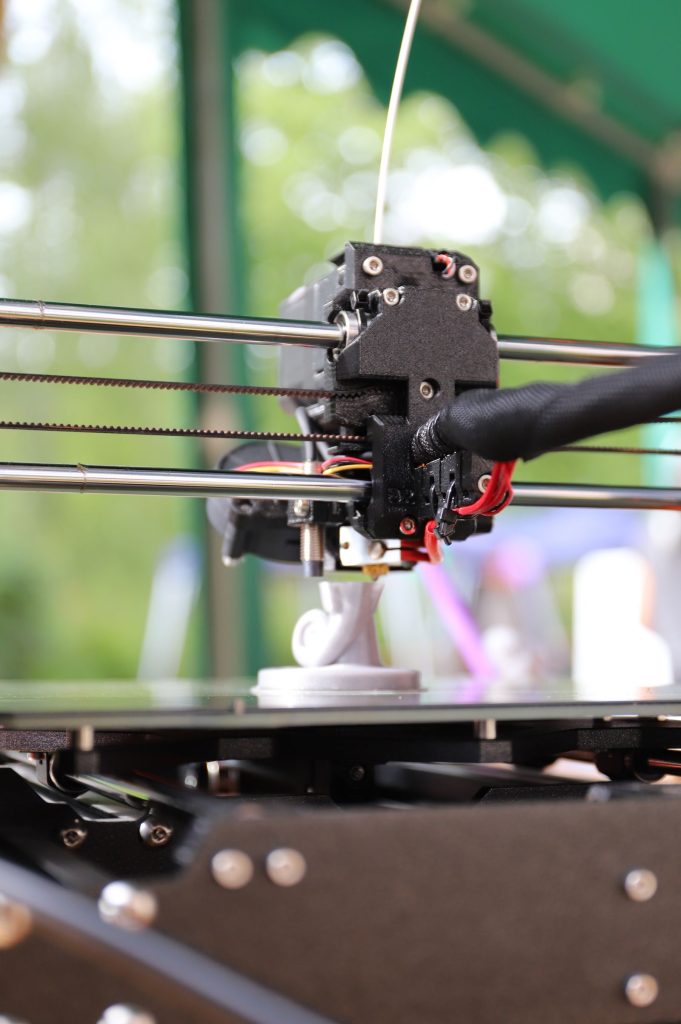
Ecological? More sparing, yes, and here are its limits
A PLA pendulum is maize and sugar cane, about 70 g of maize for a 27 g pendulum, not a felled tree, not an exotic wood come from far away: some wooden pendulums are in ebony or rosewood, species that are now protected. The body of a pendulum requires neither mine nor foundry. And it is made here, in Entraigues-sur-la-Sorgue, not on the other side of the world.
I also prefer to tell you the limits. PLA only composts in industrial composting, not in your garden. My antenna keeps carbon, steel and brass, because they are needed. Ecological, then, in the simple sense: a plant-based material, a local workshop, and no forest behind a pendulum.

What it changes in your hand
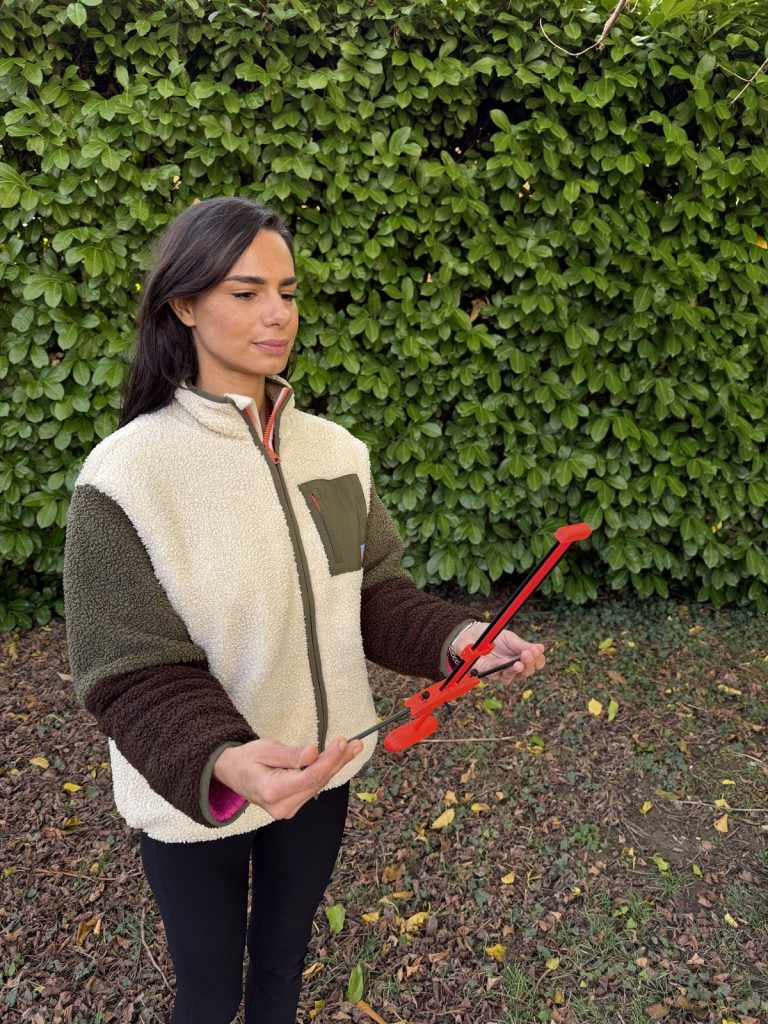
A tool that weighs what it must weigh, that does not make you tense, that can be washed, and that is yours: made by hand, for you, in the colour that suits it best, red for the antenna, green for the shape waves. And as the design is mine, a lost or broken pendulum is reprinted identically, at the same weight: one call is enough. One precaution only: do not leave it behind a windscreen in the middle of summer, it does not like heat.
If you are attached to wood or brass, keep them, truly: a pendulum you love is a pendulum that answers. But if your brass antenna is sleeping in a drawer because it made your hands tense, try mine, with its small weight removed: in one minute, you will know whether it was the weight that kept it in the drawer.
What people ask me
Does a plastic pendulum answer as well as a brass pendulum?
With me, yes, for years, at the practice as remotely. What answers is the hand, and the hand feels a weight and a shape, not a material.
Does it break?
In use, no: I thicken where it tightens, and sturdiness comes before weight. Falling on a tiled floor, it can break, like wood. In that case, I reprint it at the same weight.
Does it yellow, does it lose its shape?
It does not oxidise and does not tarnish; keep it out of direct sunlight, which dulls colours in the long run. It loses its shape only with heat, above 55 to 60 °C: no dishwasher, no windscreen in summer.
Is there nickel or lead in it?
No nickel, no lead. To compare: ordinary free-machining brass, the kind used for turned parts, contains 1.5 to 3.5% lead.
How do I clean it?
With lukewarm water and soap, then dried. Nothing else. That is what neither wood, which fears water, nor brass, which oxidises, can take so simply.
Why not wood, it is natural too?
Wood is beautiful and I love it, but two pieces of wood never have the same weight, and a wooden piece changes with humidity. For a pendulum weighed to a tenth of a gram, that does not work. I keep wood for the bases and the shape waves.
How much does it cost?
The pendulums go from €54 to €72, the large Hartmann-type Lecher antenna is €243, stand included, the amulets €45. Free shipping in France, and 14 days after receipt to change your mind. Everything is on the prices page.
Is it biodegradable?
In industrial composting, yes; in your garden, no. I prefer to tell you than to let you believe it.
Still hesitating between wood, brass and mine?
Call me: the first assessment by phone is free, and I tell you which tool sits best in your hand.
Call +33 6 80 72 12 54or write to me on WhatsApp, or at contact@centre-coherence.fr
What I describe here is an energy practice, for well-being: it makes no diagnosis, treats no illness and replaces neither medical advice, nor a treatment, nor psychological care.